
Back Pain
Most back pain is not really a back problem. It is a back symptom. Those are different, and only one of them is worth treating.
Book your first visitBook your first visit online or call (630) 435-0100.
You leave the first visit with an explanation and a plan, not a chart of the spine and a twelve-visit package.
The spot that hurts is usually not the spot that is broken. Your back sits in the middle of the chain, and when your hips, your core, or an old injury stop doing their share, the back absorbs the load. It does that quietly for years, and then it does not.
That is why back pain keeps coming back when only the sore spot gets treated, and it is the whole way I practice. I am Dr. Justin Hunter, a chiropractor in downtown Naperville with over 20 years of finding the thing upstream that keeps overloading a back, then fixing that.
Why back pain comes back
Treat only the sore spot and you get relief that lasts until the thing that caused it does it again. A hip that stopped rotating. A core that quit. An ankle injury from years back that changed how you walk, and how you have loaded your spine every day since.
Find what changed upstream and the sore spot stops getting overloaded in the first place. Most clinics treat where it hurts. Finding the actual source is the half that usually gets skipped, and it is the half that determines whether you are back in six weeks.
The three patterns I see most
These are not formal diagnoses. They are the three shapes back pain usually shows up in, and they get handled differently.
The sudden one. You lifted something, you turned wrong, and now you cannot stand up straight. Usually a joint that locked down plus a muscle in full protective spasm. Often the fastest to respond.
The desk one. Nothing happened. It just built up over months of sitting, and it aches by mid-afternoon every day. This is a movement and loading problem, and hands-on work alone will not hold it.
The one that keeps coming back. It goes away for a few months and returns, usually the same way. This is the one worth the most time, because something upstream is unresolved and nobody has looked for it.
What happens on your first visit
The conversation comes first. What you did, what you have tried, what your days look like, what has changed. Then a real examination: how you move, where the movement stops, what reproduces the pain, what the muscles and joints are doing when I have hands on them.
You leave knowing what I found, what I think is driving it, and what it will take. First visits run about an hour.
How I treat back pain
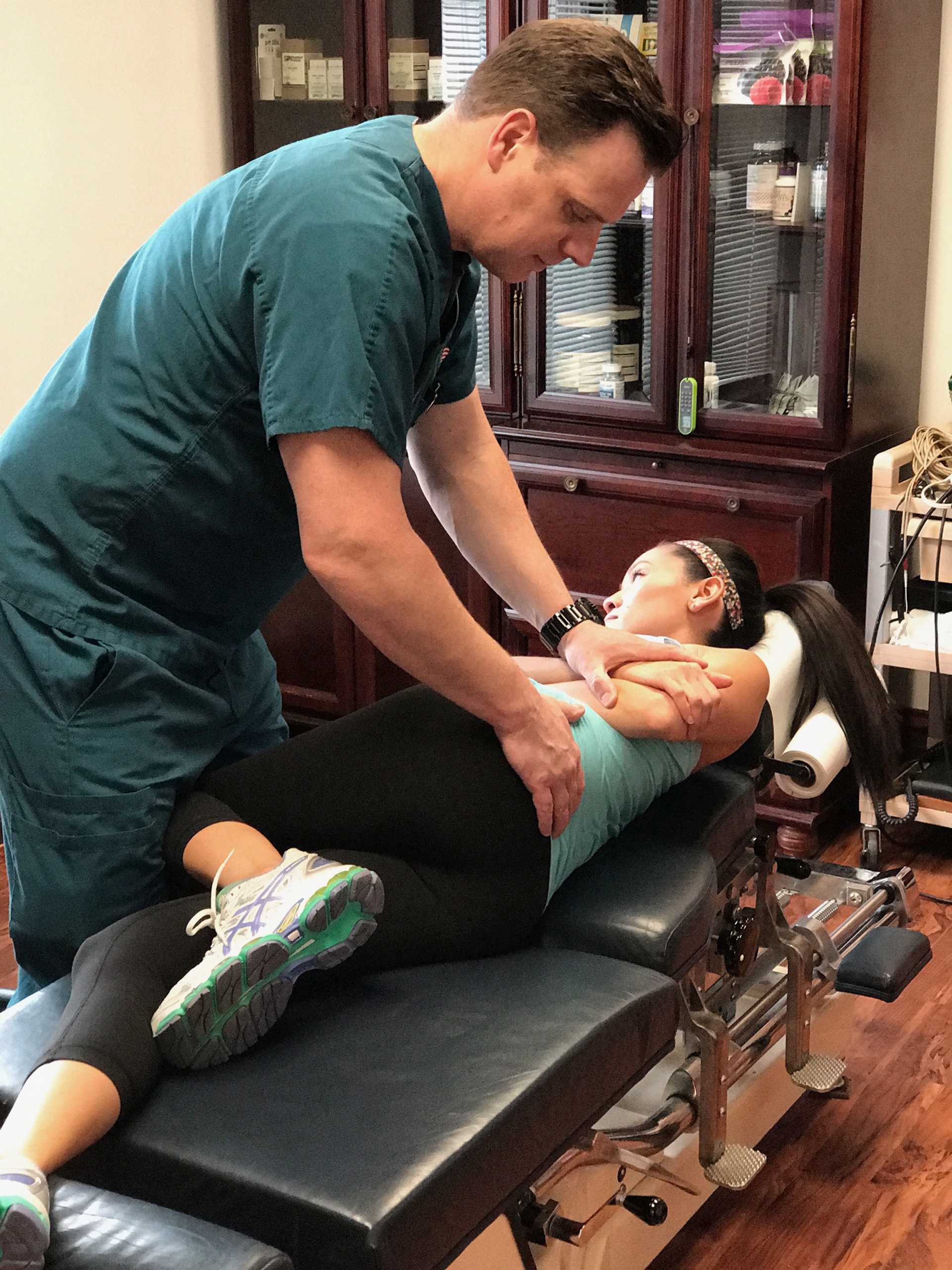
Adjustments restore movement to the spinal joints that have locked down, and just as often to the hips that stopped doing their share. Hands-on soft tissue work settles the muscles that have been guarding for weeks and the tissue that has thickened around them.
Then the part that makes it hold: rebuilding how you hinge, lift, and carry. Getting the hips to take their share of every bend. Re-engaging the deep core support that went quiet. Graded loading so your back finishes stronger than it started, not just less sore. If you lift, run, or play, that progression is built around your sport; the sports medicine page covers how I work with athletes and people who train.
And then the part most places skip entirely: changing whatever it is in your day that keeps re-creating this. Sometimes that is a chair. Sometimes it is how you get out of a car. Sometimes it is a hip you have not rotated through in years.
No prescriptions, no injections, no surgery. If you need more than I can give you, I will tell you and refer you out.
Finding what is actually overloading your back is the half most clinics skip.
When back pain needs a medical evaluation instead
Go to an emergency room, not to a chiropractor, if you have any of these:
- Loss of bladder or bowel control, or numbness through the groin.
- Weakness in a leg that is getting worse rather than better.
- Back pain after significant trauma, a fall, or a car accident that has not been medically evaluated.
- Back pain with fever, unexplained weight loss, or a history of cancer.
What better actually looks like
Not just less pain. Less pain is the first thing that happens and the easiest thing to mistake for progress.
Better means you get through a workday without thinking about it, you can pick up your kid without planning the move first, and it does not come back the next time you lift something awkward. That is the goal, and that is what I will measure against.
Ready to find out what is actually causing it?
You leave the first visit with an explanation and a plan, not a chart of the spine and a twelve-visit package.
Common Questions
How quickly will I feel better?
Many people feel a meaningful difference after the first visit. Others have layered problems that take a few weeks of consistent work to unwind. You will get a realistic timeline at the first visit based on what I find, not a template.
Do I need imaging before I come in?
Not usually. If you have recent x-rays or an MRI, bring them or send them ahead. If imaging would change the plan and you do not have any, I will tell you what to get and where.
Will I need surgery?
Most back pain does not. Surgery is sometimes the right answer, but it should be the last step, not the first. If your situation genuinely needs a surgical opinion I will say so at the first visit and refer you to someone I trust.
Do you treat back pain during pregnancy?
Yes. Pregnancy-related back and pelvic pain is common and often responds well to manual care. The techniques are modified for safety throughout pregnancy.
I have had this for years. Is it too late?
No. Long-standing pain usually means more layers to work through, not that nothing can be done. It does mean I will be honest with you at the start about what is realistic.
Is this covered by insurance?
Pure Health & Wellness is in network with Blue Cross Blue Shield PPO, Aetna PPO, PHCS PPOs, and United Healthcare PPO. In your insurance directory the practice may be listed as Hunter Family Chiropractic, PC. Same practice, same doctor, same address. Call (630) 435-0100 and I will confirm coverage for your specific plan.
Do I need a referral?
No. You can book a first visit directly. If you already have imaging or records, send them ahead or bring them with you. Helpful, but not required.