
Physical Therapy
Adjustments, soft tissue, and rehab from the same doctor, in the same visit. No handoffs.
Book a first visitWhat physical therapy looks like here
Most places, your physical therapy works like this. You see the doctor for the quick adjustment. Then you get parked in a room to do exercises on your own. Or you get a referral to a separate PT office across town, with another co-pay, another waiting room, and another stack of intake paperwork.
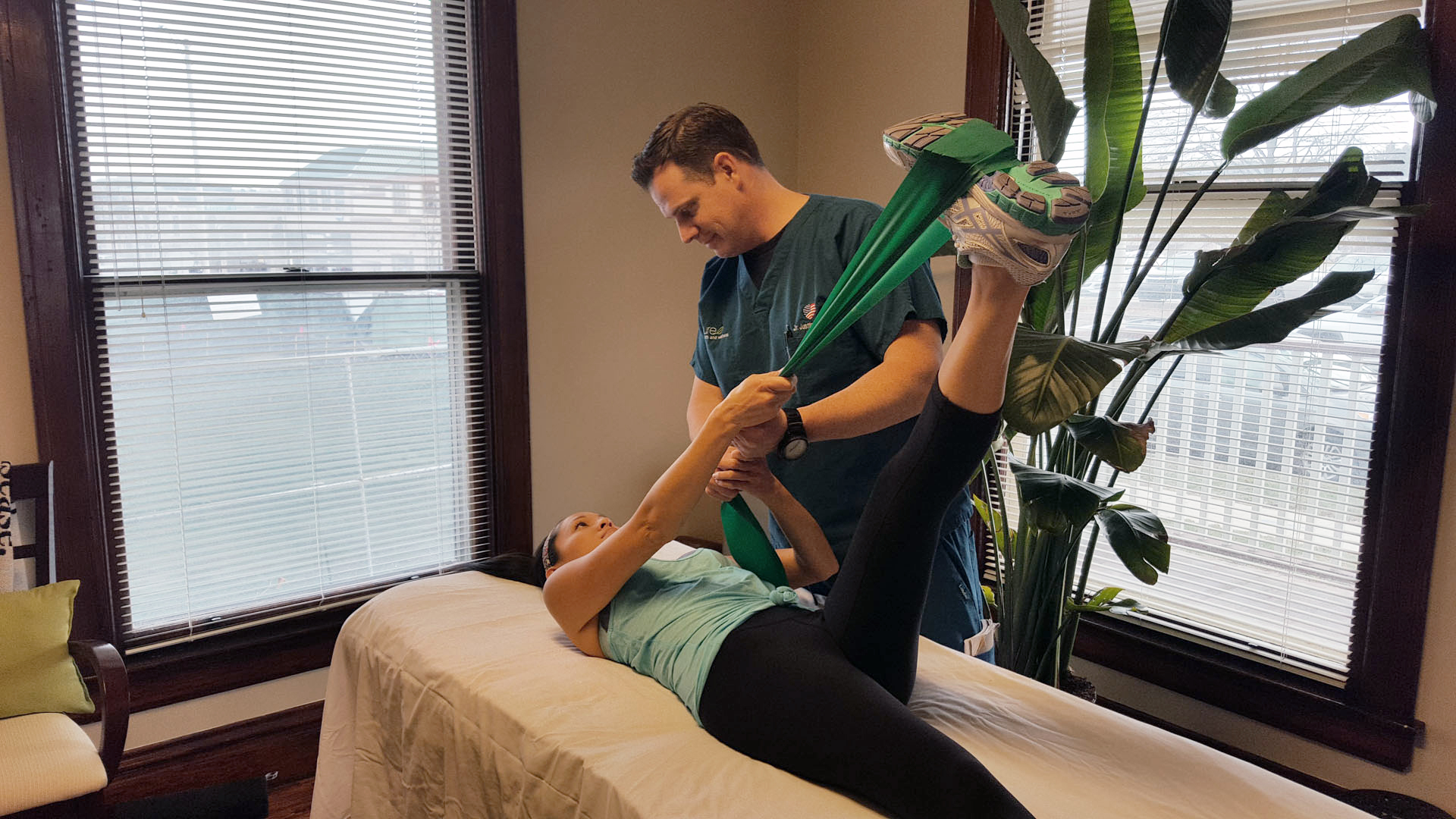
That is not how this works. When you come in, I do the listening, the exam, the adjustment, the soft tissue work, the stretching, and the rehab. Same provider, same visit, same day. I have always believed I am here to take care of people, not to pawn them off on someone else.
A lot of what people picture as physical therapy lives in this office. Hands-on soft tissue therapy to break up scar tissue and restore pliability in muscle and connective tissue. Corrective exercise and rehab to rebuild the strength and movement patterns the injury took away. Stretching, taping, and functional movement work. When a chiropractic adjustment is the right tool, I use it. When the muscle work is what is holding you back, I do that too. Most patients need both.
Why "pain stopped" does not mean "healed"
This is the part I wish more patients heard before they walked in. Just because your pain stops does not mean you are fixed.
Think about a scab. You cut yourself, you get a scab, and after three weeks it is gone. The skin underneath is pink. There is no pain, you can function. But if you bump it, what happens? It bleeds. New scab. Back to square one.
That is where most people stop their care. The pain went away, so they figure they are done. Under that pink skin, your body is still rebuilding. Collagen is still doing its work. The functional healing process for most soft tissue injuries is closer to 12 to 18 months from the date of injury. You hit about 90% in the first six months, and the last 10% comes over the year that follows. If you stop the work when the pain stops, that last 10% never shows up, and the next time you bump it, you are back at the start.
The physical therapy piece is what gets you the last 10%.
Pain leaves before healing finishes
90% healed
fully healed
Most patients stop when the pain stops, around the 90% mark. The last 10%, where tissue actually rebuilds, is the part that prevents re-injury.
Where it hurts is not always where it is broken
One of the most useful things I bring to physical therapy is the chiropractic diagnostic background. Patients come in with one problem and it turns out to be coming from somewhere else entirely.
Hip pain that x-rays and MRIs cannot find a cause for, that is actually a back problem compressing nerves and changing how the pelvis loads. A pitcher whose fastball will not break through 88 miles an hour, that turns out to be an ankle that is not pushing right off the mound. Knee pain that is really a hip stability problem. You cannot rehab what is not actually broken. Figuring out the real source of the problem is half the work, and it is the half most clinics skip.
The symptom. The hip, the knee, the leg, the spot you point to.
The source. Often higher up the chain, in the spine or how the body loads.
What this helps with
The most common things I see in this part of my practice are back pain, neck pain, rotator cuff and shoulder issues, sciatica, hip and knee pain, tendonitis, plantar fasciitis, post-injury recovery, post-surgical rehab, and the kind of nagging pain that does not show up on a scan but keeps coming back.
If you are not sure whether you need a chiropractor, physical therapy, or both, you do not have to know that before you book. I do.
Ready to figure out what is actually going on?
If you have been through rehab somewhere else and you are still not better, or you have been quietly putting up with something for months hoping it will resolve, I want to hear your story. Book a first visit and let us figure it out together.
Book a first visitCommon Questions
Are you a physical therapist?
I am a Doctor of Chiropractic. I provide physical therapy services, soft tissue work, and rehabilitation as part of chiropractic care, all within the scope of my Illinois chiropractic license. If you need a separately licensed physical therapist for something outside that scope, I will tell you and refer you to someone I trust.
Do I need a referral to come in?
No. You can book a first visit directly. If you want to send records or imaging ahead of time, that is helpful but not required.
What is the difference between chiropractic and physical therapy?
Chiropractic is focused on the joint and the nervous system. Physical therapy is focused on the muscle, the soft tissue, and the strength and movement patterns that support the joints. Most patients need both. The advantage here is you do not have to choose, or schedule two separate offices, to get both.
How long is an appointment?
First visits run about an hour. Follow-up visits vary depending on what we are working on together. There is no five-minute-and-out structure here.
Is this covered by insurance?
Pure Health & Wellness is in network with Blue Cross Blue Shield PPO, Aetna PPO, PHCS PPOs, and United Healthcare PPO. You may also see the practice listed in your insurance directory as Hunter Family Chiropractic, PC. Same practice, same doctor. Call (630) 435-0100 to confirm coverage for your specific plan.