
Knee Pain
The knee is a hinge caught between an ankle and a hip. When either one stops doing its job, the knee is what pays for it.
Book your first visitBook your first visit online or call (630) 435-0100.
Most knee pain gets blamed on the knee. You leave knowing what is actually driving yours.
The hip rotates. The ankle rolls and adapts. The knee mostly just bends and straightens, and when the joints above and below it stop doing their share, it absorbs load it was never built to handle, quietly for a while, and then not.
That is why so much knee pain arrives without an injury, and why I start at the hip and the ankle instead of only where it hurts. I am Dr. Justin Hunter, a chiropractor in downtown Naperville, over 20 years in practice.
The patterns I see most
Pain at the front of the knee or under the kneecap, worse on stairs, after sitting, or running downhill. This is the runner's knee pattern, patellofemoral pain.
Pain on the outside of the knee that shows up at a predictable point in a run and stops when you stop. Classic IT band syndrome.
Pain just below the kneecap in jumping and cutting sports. In adults this is usually patellar tendonitis, jumper's knee. In growing athletes it is often Osgood-Schlatter, which parents hear as a scary name for what is usually a manageable growth-plate irritation.
Deep, stiff, achy knees that are worse in the morning and after long inactivity, the wear-and-tear pattern.
A knee that has never been the same since a specific injury, even one from years ago.
What happens on your first visit
We start with the history, because with knees it tells you more than almost any test. When it hurts, how far into the activity, whether it eases as you warm up or gets worse, what you changed recently in your training or your shoes or your job.
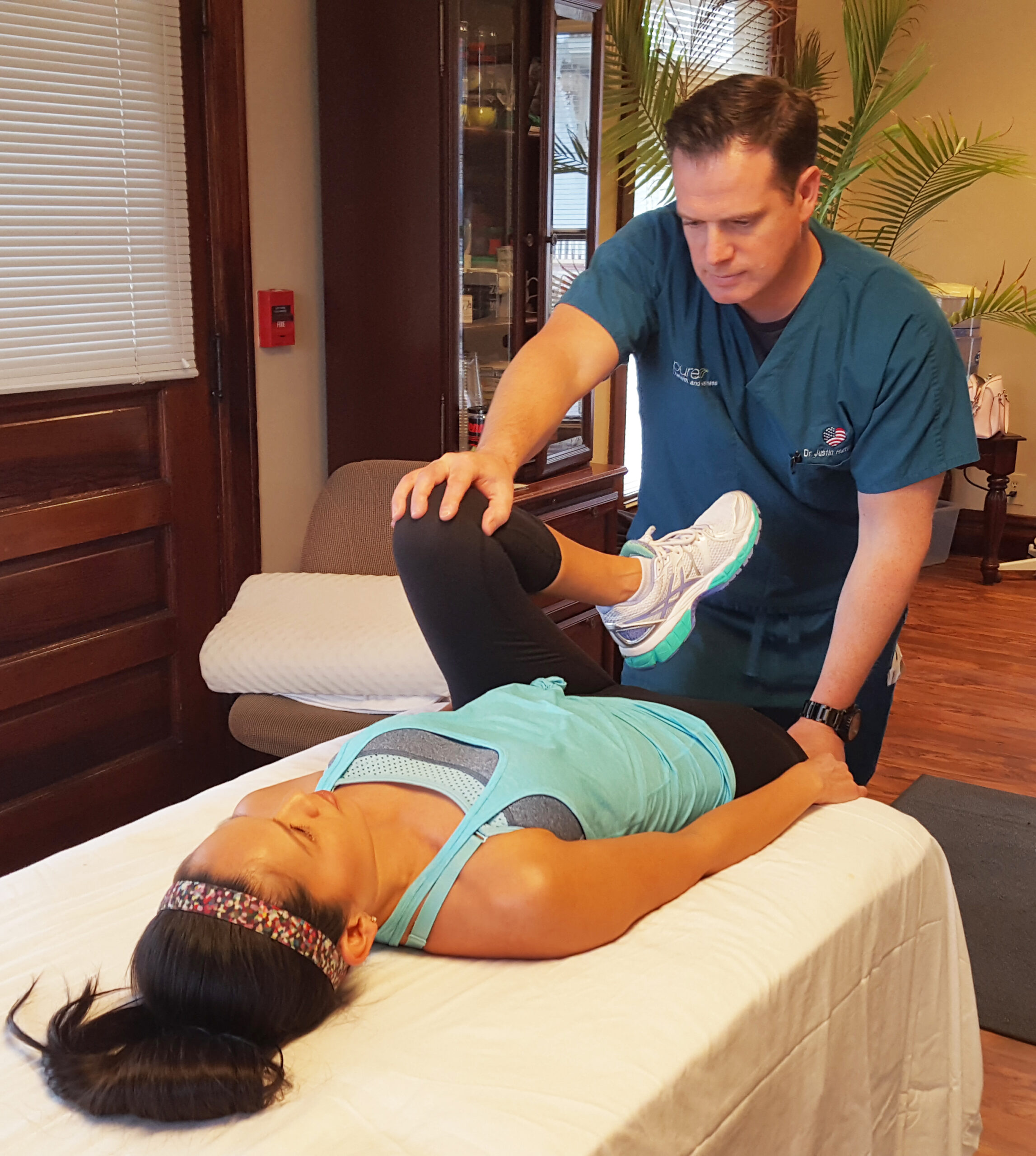
Then I watch you move. Squat, step, single leg. That is where the compensation shows up, and it shows up above and below the knee far more often than at it. Then hands-on assessment of the joint itself and everything feeding into it.
How I treat knee pain
Restore movement where it has been lost, usually at the hip, the ankle, or both, using adjustments and mobilization. Release work through the thigh, hip, and calf tissue that has tightened and is pulling the joint out of its track.
Then the part that determines whether it holds: strength through the hip and the whole leg, and retraining the movement pattern that produced the problem. The hands-on work buys the window. The movement work is what keeps it. For athletes and runners, that progression is built around your sport and your race calendar; the sports medicine page covers how that works.
No prescriptions, no injections, no surgery.
Most knee pain gets blamed on the knee. You leave knowing what is actually driving yours.
When a knee needs an orthopedic opinion
- A knee that locks, catches, or gives way underneath you
- Significant swelling that came on within hours of an injury
- A knee that will not fully straighten or fully bend
- Knee pain following a significant trauma, a collision, or a twisting injury with a pop
Ready to find out what your knee is actually paying for?
I start at the hip and the ankle instead of only where it hurts, because that is usually where the answer is.
Common Questions
Can a chiropractor treat knees?
Yes. Chiropractic is joint and movement care, and that is not limited to the spine. With knees, most of the work is at the hip and the ankle anyway, which is exactly the kind of chain problem this practice is built around.
Should I stop running?
Usually not entirely. More often we cut volume before we cut running, swap a surface or a route, and fix the mechanics while the tissue settles. Most runners keep running through treatment in some form, and the ones training for something keep their race on the calendar unless the exam says otherwise.
Is my knee pain arthritis?
It might be. And even when wear shows on an x-ray, plenty of knees move and feel substantially better once the joints around them start contributing again. Arthritis on a scan is a finding, not a verdict.
Do I need an MRI?
Not to start. If your presentation suggests something structural that would change the plan, I will tell you exactly what to get. Most knee pain does not need imaging to be sorted out.
Is this covered by insurance?
Pure Health & Wellness is in network with Blue Cross Blue Shield PPO, Aetna PPO, PHCS PPOs, and United Healthcare PPO. In your insurance directory the practice may be listed as Hunter Family Chiropractic, PC. Same practice, same doctor, same address. Call (630) 435-0100 and I will confirm coverage for your specific plan.
Do I need a referral?
No. You can book a first visit directly. If you already have imaging or records, send them ahead or bring them with you. Helpful, but not required.