
Herniated Disc
The question is never just what the imaging shows. It is whether your exam agrees.
Book your first visitBook your first visit online or call (630) 435-0100.
If you have imaging, bring it. The exam tells us whether the finding is what is actually producing your symptoms.
A herniated disc on an MRI is not the same thing as a herniated disc causing your pain. MRI studies of people with no back pain at all routinely find bulges and herniations on their scans. Comfortable people, walking around with findings that look alarming on a report.
So before anyone treats your disc, someone has to confirm that the finding on the imaging matches the findings on your exam. I am Dr. Justin Hunter, a chiropractor in downtown Naperville, and that is the first thing I do, because everything that follows depends on it.
What a herniated disc actually is
Between each pair of vertebrae sits a disc: a tough outer ring with a softer center, doing the job of a shock absorber and a hinge at the same time.
A herniation means some of that softer center has pushed out past where it belongs. If it pushes into space where nothing important is sitting, you may never know it happened. If it pushes into a nerve root, you feel it, often not in your back but down an arm or a leg.
Bulging disc, slipped disc, ruptured disc: the terms
You will hear all of these, plus protrusion. They describe different degrees of the same event, from a disc that bulges under load to one whose center has pushed through the outer ring. Nothing actually slips, and a bulging disc and a herniated disc sit on the same spectrum, which is why the treatment thinking is the same: match the image to the exam, then treat what is actually producing symptoms.
The symptoms that actually point to a disc
Pain that travels into an arm or a leg, often further than the back pain itself.
Numbness or tingling that follows a specific path rather than a general area.
Pain that spikes with coughing, sneezing, or straining.
Weakness in a specific movement, like lifting the front of your foot or gripping.
Pain that changes clearly with position, better sitting or better standing, rarely both.
What happens when you come in
Bring your imaging if you have it. The first visit is an examination first: neurological testing to identify which nerve is involved, movement testing to find your directional preference, the positions that pull symptoms up out of the limb versus push them further down. Then we put your imaging next to your exam and see whether they tell the same story.
If they match, you get a clear plan. If they do not, we keep looking for what is actually producing your symptoms, and you have been saved from treating an incidental finding.
What I can do, and what I cannot
Straight answer first: I cannot push a herniated disc back into place. Nobody can, and anyone who tells you otherwise is selling something.
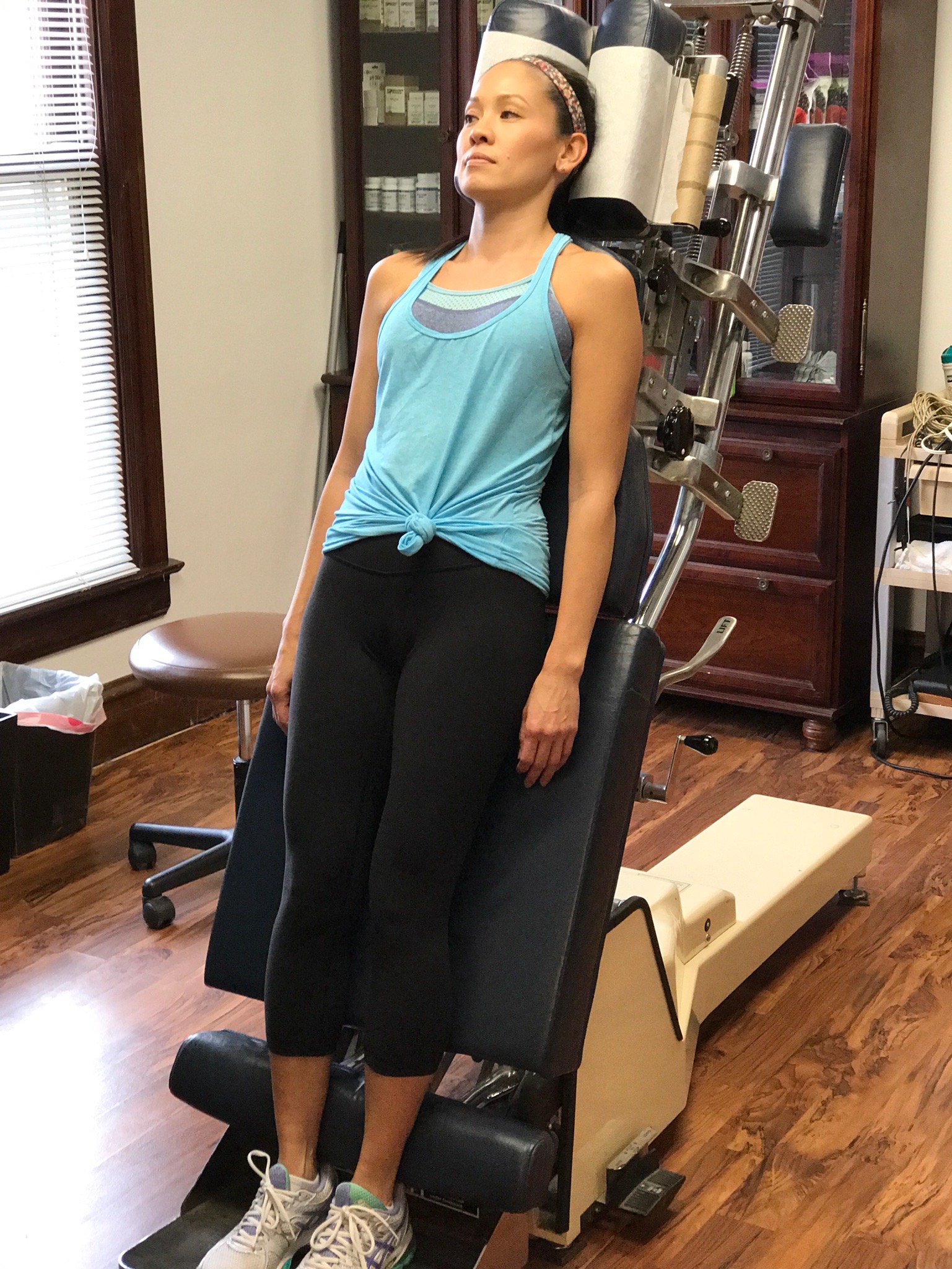
What conservative care does is take the pressure off the irritated nerve and give the tissue conditions to settle. The work is built around your directional preference: movements and positions the exam shows calm your symptoms, repeated deliberately, while the aggravating loads come out of your day temporarily. On top of that, restoring movement to the joints above and below the injured level so they stop dumping load onto it, releasing the muscles that have been guarding for weeks, and decompression and traction work where it is appropriate.
Then load management: a plan for what you lift, how you sit, and how you train while the disc settles, and a progression back to full activity that does not re-injure it on the way. Most disc herniations get better with conservative care and time. That is the honest version of the good news.
Bring the report. The exam tells us whether that finding explains what you are feeling.
When surgery is the right answer
Sometimes it is, and I will tell you when I think you are in that group rather than running you through weeks of care first.
Progressive weakness, loss of bladder or bowel control, or numbness through the groin means you need a surgical evaluation immediately, not an appointment with me. Significant, unrelenting nerve symptoms that are not responding to conservative care over a reasonable trial also belong in front of a surgeon.
I would rather send you to someone I trust and be right than keep you and be wrong.
Ready to find out what is actually causing your symptoms?
Most disc herniations get better with conservative care and time. That is the honest version of the good news.
Common Questions
Is it safe to be adjusted with a herniated disc?
When the case has been examined properly, yes, and the technique is chosen to match the situation. That is why the first visit is mostly examination. There are presentations where I would not adjust the involved segment at all, and I will tell you if yours is one of them.
Can a herniated disc heal on its own?
Often, yes. Disc material can shrink and reabsorb over months, and symptoms frequently improve well before the image changes. Conservative care is about making that window survivable and preventing the compensation patterns that outlast the injury.
I have a herniation on my MRI but almost no pain. Should I worry?
Probably not. Findings on imaging are common in people with no symptoms at all. What matters is whether the finding matches your exam. Bring the imaging in and I will tell you honestly what I think it means for you.
How long before I can go back to the gym?
Depends on what you do there. Most people get back to training sooner than they expect, with modifications to specific movements for a period. I would rather adjust your training than tell you to stop; how I handle that with athletes is covered on the sports medicine page.
Is this covered by insurance?
Pure Health & Wellness is in network with Blue Cross Blue Shield PPO, Aetna PPO, PHCS PPOs, and United Healthcare PPO. In your insurance directory the practice may be listed as Hunter Family Chiropractic, PC. Same practice, same doctor, same address. Call (630) 435-0100 and I will confirm coverage for your specific plan.
Do I need a referral?
No. You can book a first visit directly. If you already have imaging or records, send them ahead or bring them with you. Helpful, but not required.